
Deck builder
Riftbound deck builder
Start from a Champion Legend and build out its 40-card main deck, 12-card rune deck and three battlefields. Gradely flags cards outside your domains, checks your Chosen Champion, the three-copy limit and signature cards, then charts your energy curve and weighs the power each domain needs against your rune split.

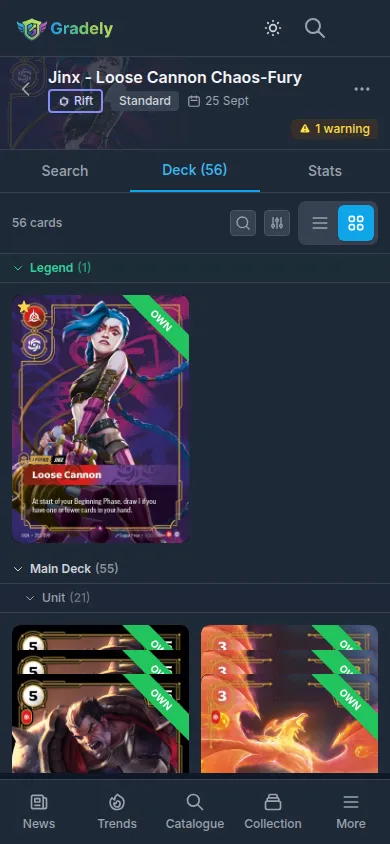
Legend and domain identity
Your Legend sets the two domains the deck can draw from. Cards from any other domain are flagged straight away.
Chosen Champion and signatures
The builder looks for the Champion unit that matches your Legend and counts signature cards, which are capped at three per deck.
Runes and battlefields
Runes and battlefields are shown in their own sections, each counted against its own size: exactly 12 runes and three different battlefields.
Energy, power and rune balance
Your energy curve sits next to your rune balance, which weighs the power each domain needs against the runes you run in it, so you can see whether your rune split can pay for the cards you are casting.
Collection-aware building
Every card shows whether you own it, own a different version such as a foil or an alternate art, or still need to find one.
Riftbound deck rules
A Riftbound deck is led by a Champion Legend, whose two domains decide which cards and runes you may play. The main deck is 40 cards and includes your Chosen Champion, a Champion unit that matches the Legend. Alongside it sit a rune deck of exactly 12 runes and three battlefields with different names. You may play up to three copies of a card and up to three signature cards in total.
Supported formats
- Standard
- The official constructed format with every released set legal, built around a Legend, 40 main deck cards, 12 runes and 3 battlefields.
- Casual
- No legality or copy checks, for learning the game, trying new champions or house rules.
Riftbound preconstructed decks
All preconsHow it works
- 1
Sign up free and create a Riftbound deck, then choose your Champion Legend.
- 2
Add your Chosen Champion, main deck cards, runes and three battlefields.
- 3
Check domains, curves and rune balance, then publish your list or keep it private.
Frequently asked questions
Does it enforce domain identity?
Yes. Cards from any domain outside your Legend's two are flagged.
Does it check the Chosen Champion?
Yes. The builder warns you when the deck has no Champion unit matching your Legend.
How are runes and battlefields shown?
In their own sections, each counted against its own size: 12 runes and three different battlefields.
Can I keep a sideboard?
Yes. A sideboard of up to 10 cards and a maybeboard sit beside the main deck for testing and match play.