Portfolio tracker
A portfolio tracker for trading cards
Gradely values your singles and sealed product, and records what you paid for graded cards, across Magic: The Gathering, Pokémon, One Piece Card Game, Flesh and Blood, Sorcery: Contested Realm, Riftbound, Disney Lorcana and Gundam Card Game, in your currency. Because every copy records what you paid and when, the portfolio shows your real cost basis, unrealised gains, and the gains you locked in when you sold.

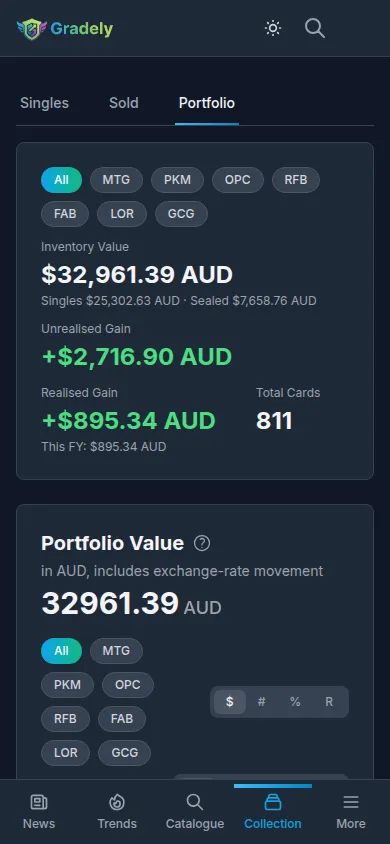
Cost basis from real purchases
Every copy carries its purchase price and date, so gains are measured against what you actually paid, not against a guess.
Singles, sealed and graded
See how your collection splits between raw singles, sealed product and graded cards, with the value of singles and sealed and what you paid for graded cards.
Value over time
Follow the value of the whole collection, or one game, over time, with total cost basis and unrealised gain beside it.
Realised gains from sales
Mark copies as sold and the gain or loss against your purchase price is recorded, separate from what you still hold.
Top gainers and losers
Spot the cards that have moved most since you bought them, in either direction.
One currency, any market
Everything is valued in the currency you choose from those we support, so collectors anywhere see numbers that make sense to them.
Every game you collect
Magic: The Gathering portfolio tracker
Magic value sits mostly in singles: reserved list staples, Commander favourites and the foil or borderless printings of them. Tracking each printing and finish separately keeps a showcase foil from being valued as the base card, while collector booster boxes and Secret Lair drops are tracked as sealed.
Pokémon card portfolio tracker
For many Pokémon collectors the portfolio starts with sealed: Elite Trainer Boxes, booster boxes and booster bundles held unopened. Singles follow, led by illustration rares, and Gradely records what you paid for graded slabs alongside their grader and grade.
One Piece card portfolio tracker
One Piece portfolios lean on sealed booster boxes and premium boosters, then on the parallels, manga art and Treasure Rares pulled from them. Each print is tracked on its own, so a chase parallel is never valued as the regular card.
Flesh and Blood portfolio tracker
In Flesh and Blood, finish drives value: cold foil legendaries, rainbow foils, marvels and first edition prints from the early sets. Booster displays and Blitz decks round out the sealed side.
Sorcery: Contested Realm portfolio tracker
Sorcery value tracks edition and rarity: Alpha against Beta, foil against non-foil, and Uniques above everything else. Booster boxes from each set sit beside the singles as sealed holdings.
Riftbound portfolio tracker
Riftbound value concentrates in overnumbered cards, signature prints and alternate art foils, each tracked by its own collector number. Booster displays are tracked as sealed.
Disney Lorcana portfolio tracker
Lorcana portfolios often lead with sealed booster boxes and starter decks, then Enchanted and Iconic cards, the rarest pulls in each set. Foil copies are valued apart from non-foil ones.
Gundam Card Game portfolio tracker
Gundam Card Game value sits in Legendary Rares and their parallel prints, which share a card number with the regular print but not its price. Booster boxes and starter decks are tracked as sealed.
How it works
- 1
Sign up free and add your cards and sealed product with what you paid.
- 2
See the total value of your collection in your currency straight away.
- 3
Upgrade to a paid plan for value over time, allocation, gains and top movers.
Frequently asked questions
Is the portfolio tracker free?
Your collection's total value and card count are free. Full portfolio analytics, including value over time, allocation, gains and top movers, are available on paid plans.
How is my cost basis worked out?
From the purchase price you record on each copy. If you bought the same card twice at different prices, both purchases count.
Does it track sealed product?
Yes. Booster boxes, Elite Trainer Boxes, displays, starter decks and more are valued alongside your singles and shown as their own slice of the portfolio.
Can I see realised gains?
Yes. When you mark a copy as sold, the gain or loss against its purchase price moves into your realised gains.
Can I see one game on its own?
Yes. On paid plans, filter the portfolio to a single game to see its value, cost and gains apart from the rest.
Which currency are values shown in?
The one you choose in your settings. Every card and product is valued in that currency.