Trade calculator
Trade cards face to face, with the numbers on your side
Gradely's Trade table is built for trading in real life: two players, two piles of cards, one phone. Scan or search the cards each side brings across Magic: The Gathering, Pokémon, One Piece Card Game, Flesh and Blood, Sorcery: Contested Realm, Riftbound, Disney Lorcana and Gundam Card Game, see market prices in your currency, and get the difference in plain words. The trading starts before you arrive: browse trade binders from home or on the commute and know what you're after before you sit down. No account needed, and once you sign up free, every trade you record keeps your collection and portfolio up to date.

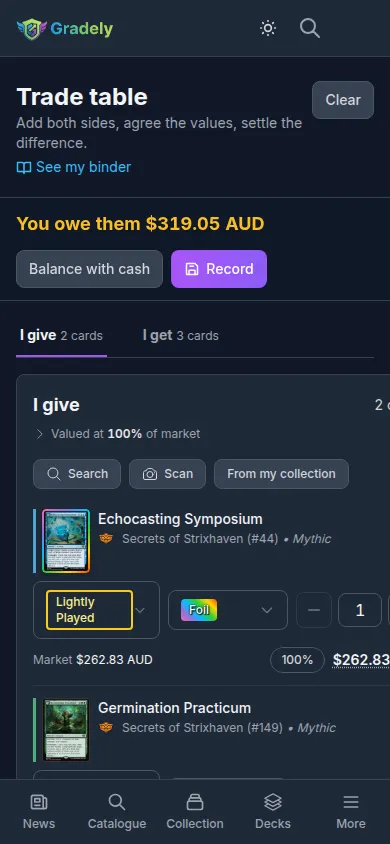
Built for the table
What you give and what you get on one screen, each with its own total, and the difference worded for you: they owe you, you owe them, or even.
Scan or search on the fly
Point your phone at a card or search for it, including sealed product. Copies of the same card, finish and condition stack into one line with a quantity.
Browse binders before you go
Open a player's trade binder from home, on the commute or after the event. Signed in, you see which of their cards are on your wishlist and can put them on the table before you meet.
Prices for the condition
Prices are collected from retailers and other sources and shown in your currency, for each card's condition and finish. When there is no price for that exact condition, the line says what it is priced at.
Percentages and agreed values
Set a percentage for each side, change one card on its own, or type the value you agreed. Add cash to either side, or call it even in one tap.
Your portfolio keeps up
Record the trade in one tap: what you gave is sold at the agreed value, what you got is added at that cost, and your portfolio and gains follow. A QR code lets the other player record their side too.
Deals
Leave your treasures secure at home
Agree the trade before you meet. Bring only the deal.
Found what you want in someone's trade binder? Put the trade together from home, on the commute or the night before, and send it as a deal. Sending it counts as your agreement. They can agree, change it or decline, and any change comes back to you. Once you've both agreed, only the cards in the deal need to leave the house: open it at the table, check the cards and record it in one tap.
Agree from home
Build the deal from their binder on the Trade table, with market prices for every card, and add a preset note.
Bring only the deal
No more carrying your whole collection to an event. Pack the cards you agreed to trade and keep the rest safe at home.
Never promised twice
A card you have agreed to trade cannot be promised to someone else, and if it sells or leaves your binder the deal comes back to you both.
On your terms
Choose who can send you deals: anyone, people you have traded with, or nobody. Deals from new traders arrive quietly.

Every game you trade
Magic: The Gathering trade calculator
Magic trades turn on printings: a foil, borderless or showcase copy can be worth many times the base card, so each line is priced for its own printing and finish. Commander staples are where agreeing a percentage matters most.
Pokémon card trade calculator
Pokémon trades often mix singles with sealed product. Illustration rares are priced as their own printing, and Elite Trainer Boxes or booster bundles can go on the table beside them.
One Piece card trade calculator
One Piece parallels, manga art and Treasure Rares share a card number with the regular print but not its price, so each is added and priced as its own printing.
Flesh and Blood trade calculator
In Flesh and Blood, finish drives value: cold foils, rainbow foils and marvels are priced apart from the non-foil card, and a line's finish can be changed on the table.
Sorcery: Contested Realm trade calculator
Sorcery value tracks edition and finish: an Alpha copy is not a Beta copy, and a foil is not a non-foil. Pick the printing you are trading and the price follows it.
Riftbound trade calculator
Riftbound overnumbered cards, signature prints and alternate art foils each have their own collector number, so the line carries the exact print being traded and its price.
Disney Lorcana trade calculator
Lorcana trades often hinge on Enchanted and Iconic cards, the rarest pulls in each set. Foil and non-foil copies are priced apart, and sealed booster boxes can join a trade too.
Gundam Card Game trade calculator
Gundam Card Game Legendary Rares and their parallel prints share a card number but not a price, so each is priced as its own printing on the table.
How it works
- 1
Browse trade binders before the event, or open the trade table when you sit down.
- 2
Scan or search the cards each side brings, agree a percentage or a value per card, and settle any difference with cash.
- 3
Sign up free to record the trade and keep your collection and portfolio up to date, then show the QR so the other player can record theirs.
Frequently asked questions
Can I trade without an account?
Yes. Open the trade table and scan or search the cards on the fly, for both sides, and the prices and the difference work straight away. Trade binders can be browsed without an account too. You only need one, free, to record trades in your collection or to have a binder of your own.
Is the trade calculator free?
Yes. The calculator is free, and so is recording your trades in your collection.
Where do the prices come from?
We collect prices from retailers and other external sources and show them in your currency. Each line is priced for its condition and finish where that price exists. Graded cards are never priced as raw copies, so you type the value you agree.
Does the other person need Gradely?
No. The calculator needs only one phone. Once you record the trade, a QR code lets the other person add the same trade to their own collection, and signing up free from it keeps the cards they got.
What happens when I record a trade?
The cards you gave are marked as traded at the agreed value, which records your realised gain, and the cards you got are added with the agreed value as what you paid. Your portfolio follows straight away, and every card in the trade gets a tag such as trade_280926, so you can find the trade later.
Can I undo a trade?
Yes, for 24 hours after you record it. After that, edit the copies or mark them unsold from your collection.
Can we agree a trade before we meet?
Yes. Open their trade binder, put the trade together on the trade table and send it as a deal. They agree, change it or decline from their phone, and once you've both agreed you bring only those cards and record the trade at the table. Deals are free with an account.
Can I trade from someone's trade binder?
Yes, before the event, at it or after. A trade binder lists the cards a player has up for trade. Open the trade table from it and their cards are one tap away, along with the cards they have that are on your wishlist.